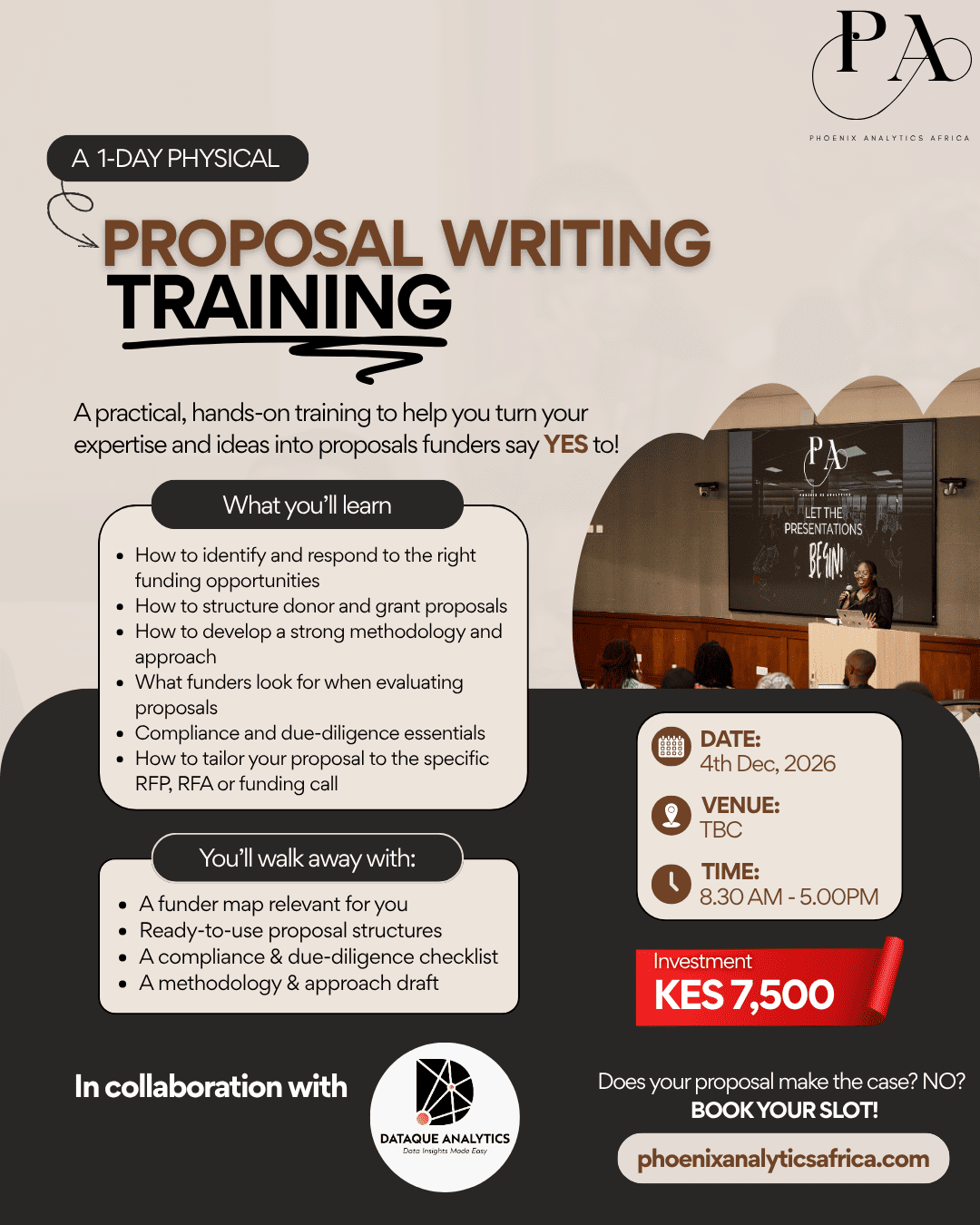
About this event
Why This Training Is Needed
International organizations designing initiatives in Kenya routinely lose funding opportunities not because their ideas are weak, but because their proposals fail to meet the technical, financial and compliance expectations of donors, grant-makers and government partners. Programme staff are often strong implementers but have limited structured exposure to proposal architecture, donor logic, budgeting, and results frameworks. This training closes that gap.
Specifically, the training responds to the following observed needs among the target audience:
• Limited familiarity with how donor funding proposals differ in structure and expectation from business/grant applications and internal program activity proposals.
• Weak articulation of problem statements, theory of change, and results frameworks that funders can quickly assess and trust.
• Difficulty translating sector realities in Kenya (health, education, agriculture, WASH, governance, livelihoods, climate, humanitarian response) into fundable, locally-grounded narratives.
• Inconsistent budgeting practices that do not align narrative activities with costed line items, leading to rejected or heavily revised submissions.
• Low awareness of compliance, safeguarding, and due-diligence requirements that many donors and grant bodies now require at proposal stage.
• Missed opportunities due to proposals that are generic rather than tailored to a specific call, RFP/RFA, or grant guideline.
By the end of the programme, participants will move from ad-hoc, reactive proposal writing to a structured, donor-responsive, and sector-informed approach that increases the organization's win rate and strengthens its credibility with funding partners operating in Kenya.
Training Overview
This training lays the foundation for the full programme. It orients participants to the funding landscape in Kenya, builds a shared understanding of what distinguishes a donor proposal from a business grant application and a program activity proposal, equips participants with a bare-minimum outline for each proposal type plus the compliance essentials funders now expect, and tackles the area most proposal writers struggle with most while designing a credible methodology and approach for different program contexts. The day is structured in four progressive sections, moving from context-setting to hands-on practice.
Day's Outline
Time | Session | Focus / Output |
|---|---|---|
8:30 – 9:00 | Registration & Welcome | Icebreaker, introductions, expectations mapping |
9:00 – 9:30 | Opening & Training Orientation | Rationale, objectives, ground rules, pre-assessment |
9:30 – 10:45 | Section A: The Kenya Funding & Proposal Landscape | Donor mapping, funding streams, sector priorities |
10:45 – 11:00 | Health Break | |
11:00 – 12:30 | Section B: Anatomy of a Proposal — Three Contexts | Donor vs. business grant vs. program activity proposals |
12:30 – 13:30 | Lunch Break | |
13:30 – 15:00 | Section C: Bare-Minimum Outlines, Comparison & Compliance | Outline by proposal type, comparison worksheet, due-diligence checklist |
15:00 – 15:15 | Health Break | |
15:15 – 16:30 | Section D: Methodology & Approach by Program Context | IT assignments, evaluations, WASH, gender & inclusion, agriculture/circular economy |
16:30 – 17:00 | Recap, Q&A & Day One Evaluation | Key takeaways, muddiest-point check, preview of Day Two |
- Date
- December 4, 2026
- Time (EAT)
- 8.30 am - 5 pm
- Venue
- TBC